Does Stress Really Cause Gray Hair?
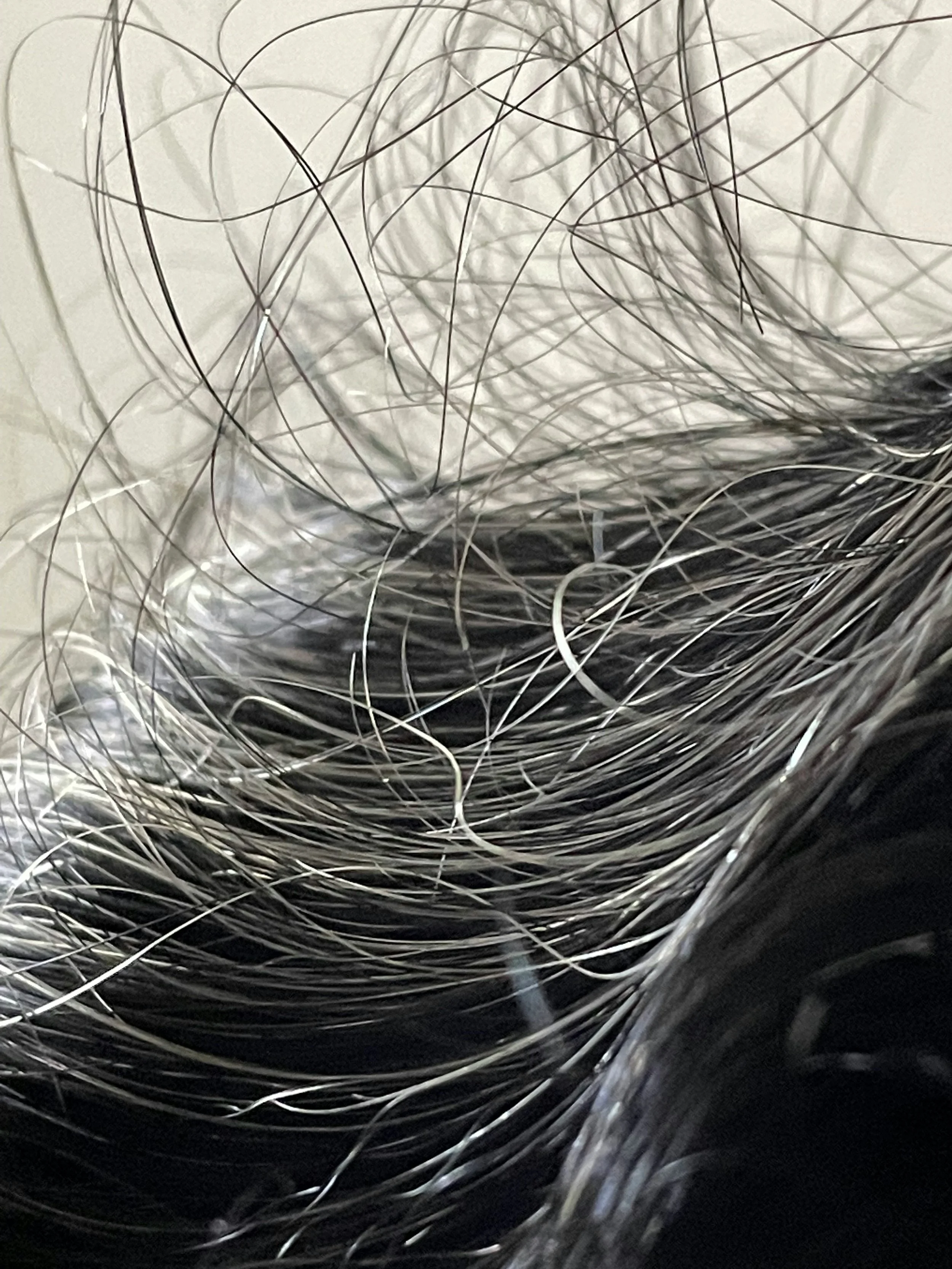
Well...I hate to be the bearer of bad news, but yes—it really can.
Before you start blaming your kids, your job, or your husband (😉), let's clear something up...
Stress isn't the only reason people go gray. Genetics are still the biggest factor, and aging is simply part of life. But stress, nutrition, and even certain health conditions can absolutely speed up the process.
So...what's actually happening?
Without getting too science-y...
Your hair gets its color from something called melanin—the pigment that also gives color to your skin and eyes. Melanin is produced by special cells inside your hair follicle.
Over time, those little pigment-producing factories start slowing down...and eventually, some of them simply stop working.
Here are a few reasons why that happens:
Your Pigment Cells Get Tired
Think of your pigment-producing stem cells like employees nearing retirement.
After years of faithfully showing up to work, they eventually clock out for good. Once they're gone, new hair grows in without color...hello, silver!
Your Hair Basically Bleaches Itself
Believe it or not, your body naturally produces small amounts of hydrogen peroxide.
Normally, an enzyme called catalase cleans it up before it causes any problems. As we age, we produce less catalase, so hydrogen peroxide starts hanging around longer—and can actually bleach your hair from the inside out.
Crazy, right?
What Can Cause Hair to Gray Earlier?
Stress
Unfortunately...yes.
Research shows that chronic stress can send signals that force pigment stem cells to leave the hair follicle too soon. Once they're gone, they don't magically come back.
So while one stressful Tuesday probably isn't giving you gray hair overnight, months or years of ongoing stress can definitely play a role.
Health & Nutrition
Your hair is often one of the first places your body shows that something is off.
Low levels of vitamin B12, iron deficiency, thyroid issues, and other nutritional imbalances can all contribute to premature graying.
Smoking
Here's another reason to ditch the cigarettes.
Smoking increases harmful free radicals in the body, which damage the cells responsible for producing pigment. Studies consistently show that smokers tend to gray earlier than non-smokers.
Can Gray Hair Be Reversed?
This is probably the question everyone wants answered.
Unfortunately, most of the time, no. Once a hair grows in without pigment, it typically stays that way. That's because the cells responsible for creating color are no longer doing their job.
However, if premature graying is related to an underlying health issue—such as a vitamin B12 deficiency, low iron levels, or a thyroid condition—addressing that issue may help slow additional graying. In some cases, a small amount of natural pigment may even return, though that's the exception rather than the rule.
As for stress? While some newer research suggests that reducing significant stress may allow a small amount of pigment to return in certain situations, it isn't something you can reliably count on.
So if you've been hoping that a relaxing vacation will magically turn all your gray hairs brown again...I'm sorry to disappoint. 😉
Cover It...or Embrace It?
Here's the good news: gray hair isn't what it used to be.
For years, many women felt like they had only two choices:
Color their roots every 3–4 weeks...
Or stop coloring completely and suffer through an awkward grow-out phase.
Thankfully, that's no longer the case.
Some of my guests love the look of full gray coverage. They enjoy a rich, consistent color and don't mind keeping up with regular appointments.
Others reach a point where they're simply tired of the maintenance. They don't necessarily want to "go gray" overnight—they just want their hair to work with them instead of against them.
That's where gray blending has become such a game changer.
Instead of creating a harsh line every time your roots grow in, gray blending softens the transition between your natural gray and your colored hair. The result is a more dimensional, natural look that allows you to go longer between appointments while still feeling polished and put together.
One of my favorite parts of my job is helping clients figure out which option fits their lifestyle. My goal isn't to convince you to keep coloring your hair forever—or to talk you into embracing your gray if you're not ready.
My goal is simply to help you feel confident every time you look in the mirror.
The Bottom Line
Gray hair is completely normal. It can be influenced by genetics, aging, stress, nutrition, smoking, and even certain health conditions—but no matter how it arrives, it doesn't define your beauty.
Whether you've just discovered your first silver strand or you've been coloring your roots for years, you have options.
Maybe that means continuing to cover every gray. Maybe it means starting the gray blending journey. Or maybe it means embracing every silver strand with confidence.
Whatever your goal, I'd love to help you create a plan that's realistic, beautiful, and uniquely yours.
Because at the end of the day, it's not about hiding your age—it's about loving your hair in every season of life.